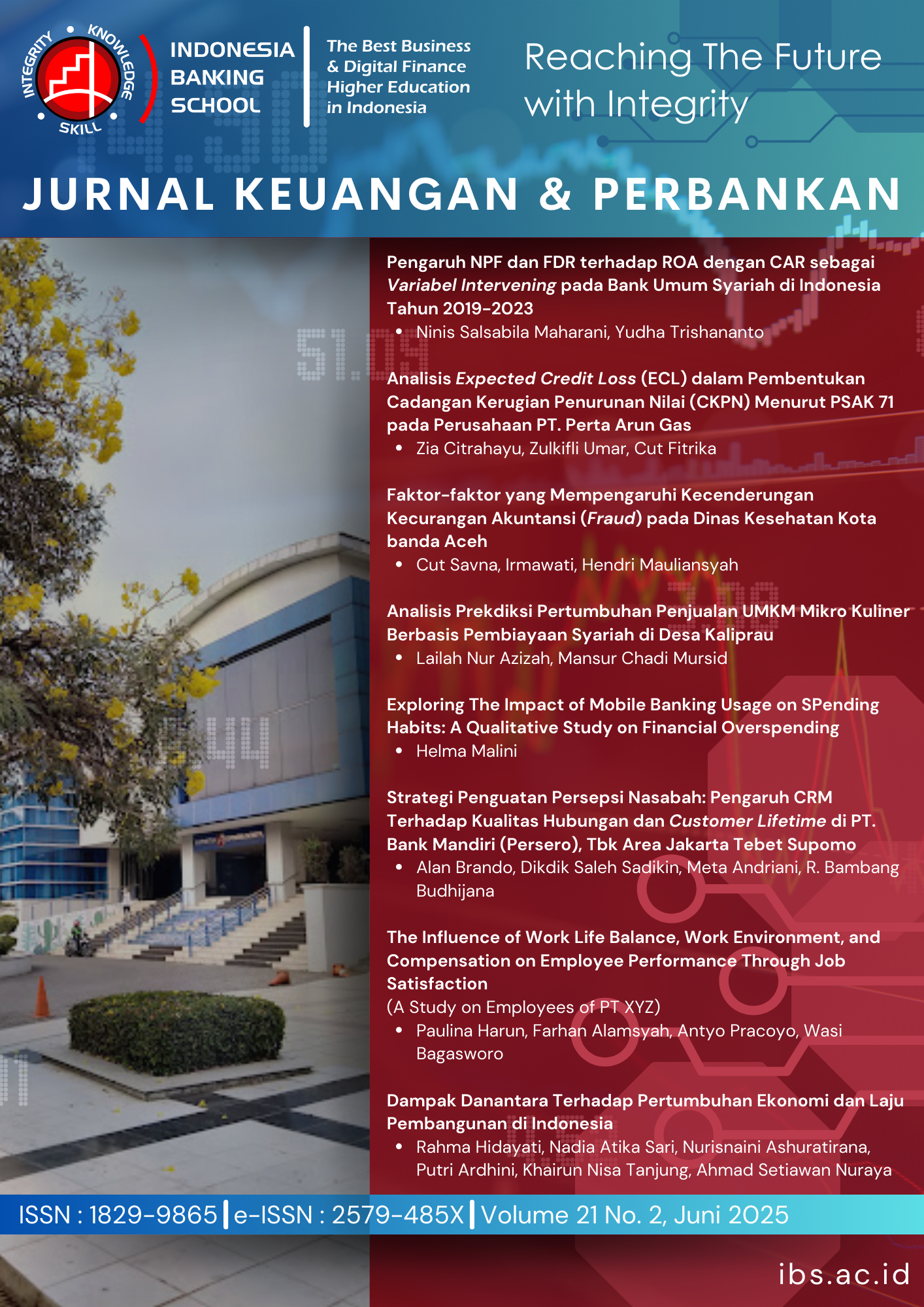
Exploring The Impact of Mobile Banking Usage on Spending Habits: A Qualitative Study on Financial Overspending
DOI:
https://doi.org/10.35384/jkp.v21i2.668Keywords:
Mobile Banking, Spending Habits, Financial Overspending, Behavioral Finance, Technology and Consumer BehaviorAbstract
This study examines the influence of mobile banking on spending habits, focusing on its role in facilitating overspending. Utilizing a qualitative approach with an exploratory case study design, data were collected through in-depth interviews, focus group discussions, and document analysis to explore the interplay between mobile banking features and behavioral tendencies. The findings reveal a dual impact of mobile banking on financial behavior. On the positive side, mobile banking enhances financial awareness and discipline by providing tools such as real-time transaction monitoring, automated savings mechanisms, and budgeting features, enabling users to make informed decisions and maintain better control over their finances. However, the convenience and immediacy of mobile banking also present challenges, particularly the ease of completing transactions, which can encourage impulsive spending and reduce traditional psychological barriers to overspending. These insights highlight the need for targeted strategies to maximize the benefits of mobile banking while mitigating its risks. The study emphasizes the importance of designing responsible financial technologies and educational initiatives to promote disciplined financial behavior. Further research is suggested to explore the long-term effects of mobile banking usage on financial habits, including saving patterns, debt management, and overall financial health, with the goal of fostering a more financially resilient society.
References
Annells, M. (1996). Grounded theory method: Philosophical perspectives, paradigm of inquiry, and postmodernism. Qualitative Health Research, 6(3), 379–393.
Bons, R. W. H., Alt, R., Lee, H. G., & Weber, B. (2012). Banking in the Internet and mobile era. Electronic Markets, 22, 197–202.
Boz, E., & Tesar, L. (2021). Debt: The Good. The Bad. The Ugly. IMF Economic Review, 69(1), 1.
Carrier, L., & Maurice, D. (1998). Beneath the Surface: the Psychological Side of Spending Behaviors. Journal of Financial Planning, 11(1).
Choe, Y. (2021). Essays on Mental Budgeting and Consumer Spending Behavior.
Creswell, J. W., Hanson, W. E., Clark Plano, V. L., & Morales, A. (2007). Qualitative research designs: Selection and implementation. The Counseling Psychologist, 35(2), 236–264.
Dittmar, H., & Beattie, J. (1998). Impulsive and excessive buying behaviour. In Choice and public policy: The limits to welfare markets (pp. 123–144). Springer.
Gautam, M. (2022). Factors Affecting the Banking Habit of Urban People. Management Dynamics, 25(2), 31–38.
Glatt, M. M., & Cook, C. C. H. (1987). Pathological spending as a form of psychological dependence. British Journal of Addiction, 82(11), 1257–1258.
Graff, B. (2016). Not buying it: Stop overspending and start raising happier, healthier, more successful kids. Hachette UK.
Gu, J.-C., Lee, S.-C., & Suh, Y.-H. (2009). Determinants of behavioral intention to mobile banking. Expert Systems with Applications, 36(9), 11605–11616.
Gurusamy, R. (2024). Digital payment technology and consumer behaviour–Saving, spending patterns: Are saving and spending patterns a concern? Journal of Information Technology Teaching Cases, 14(2), 223–226.
Heath, C., & Soll, J. B. (1996). Mental budgeting and consumer decisions. Journal of Consumer Research, 23(1), 40–52.
Heffernan, S. (2005). Modern banking. John Wiley & Sons.
Hinson, R. E. (2011). Banking the poor: The role of mobiles. Journal of Financial Services Marketing, 15, 320–333.
Honan, T. M., & Ciotti, V. G. (2000). Information technology: Doing more, spending less. Healthcare Financial Management, 54(5), 44.
Karle, H., Kirchsteiger, G., & Peitz, M. (2015). Loss aversion and consumption choice: Theory and experimental evidence. American Economic Journal: Microeconomics, 7(2), 101–120.
Kaufman, R. T., & Woglom, G. (2005). Modifying endowment spending rules: Is it the cure for overspending? Journal of Education Finance, 146–171.
Kinslin, D. (2025). Impact of Regulations on Fintech Firms/Banking and Non-Banking Financial Services. In Examining Global Regulations During the Rise of Fintech (pp. 371–428). IGI Global.
Kumhof, M., & Jakab, Z. (2016). The truth about banks. Finance & Development, 53(1), 50–53.
Mbama, C. I. (2018). Digital banking services, customer experience and financial performance in UK banks. Sheffield Hallam University (United Kingdom).
Merhi, M., Hone, K., Tarhini, A., & Ameen, N. (2021). An empirical examination of the moderating role of age and gender in consumer mobile banking use: a cross-national, quantitative study. Journal of Enterprise Information Management, 34(4), 1144–1168.
Morris, S. B., McDaniel, M. A., Worst, G. J., & Timm, H. (1995). Vanity-motivated overspending: Personnel screening for positions of trust. Educational and Psychological Measurement, 55(1), 95–104.
Moser, C., Schoenebeck, S. Y., & Resnick, P. (2019). Impulse buying: Design practices and consumer needs. Proceedings of the 2019 CHI Conference on Human Factors in Computing Systems, 1–15.
Nier, E., & Baumann, U. (2006). Market discipline, disclosure and moral hazard in banking. Journal of Financial Intermediation, 15(3), 332–361.
Servon, L. J., & Kaestner, R. (2008). Consumer financial literacy and the impact of online banking on the financial behavior of lower‐income bank customers. Journal of Consumer Affairs, 42(2), 271–305.
Shafir, E., & Thaler, R. H. (2006). Invest now, drink later, spend never: On the mental accounting of delayed consumption. Journal of Economic Psychology, 27(5), 694–712.
Shaikh, A. A. (2016). Examining consumers’ intention, behavior, and beliefs in mobile banking adoption and continuous usage. University of Jyväskylä.
Shefrin, H. M., & Thaler, R. H. (1992). Mental accounting, saving, and self-control. Choice over Time, 287–330.
Sotiropoulos, V., & d’Astous, A. (2013). Attitudinal, self-efficacy, and social norms determinants of young consumers’ propensity to overspend on credit cards. Journal of Consumer Policy, 36, 179–196.
Stilley, K. (2008). Influences on Spending: Mental Accounts and Self-Control. Advances in Consumer Research, 35.
Tiwari, R., Buse, S., & Herstatt, C. (2006). Customer on the move: Strategic implications of mobile banking for banks and financial enterprises. The 8th IEEE International Conference on E-Commerce Technology and The 3rd IEEE International Conference on Enterprise Computing, E-Commerce, and E-Services (CEC/EEE’06), 81.
To, W.-M., & Lai, L. S. L. (2014). Mobile banking and payment in China. It Professional, 16(3), 22–27.
Tóth, A., Juhász, T., & Kálmán, B. (2020). Determinants of financial habits. Journal of International Scientific Publication: Economy and Business, 14(1), 237–256.
Downloads
Published
How to Cite
Issue
Section
License
Copyright (c) 2025 Jurnal Keuangan dan Perbankan

This work is licensed under a Creative Commons Attribution-NonCommercial 4.0 International License.
 Abstract Views: 1598
|
Abstract Views: 1598
|  File Downloads: 1569