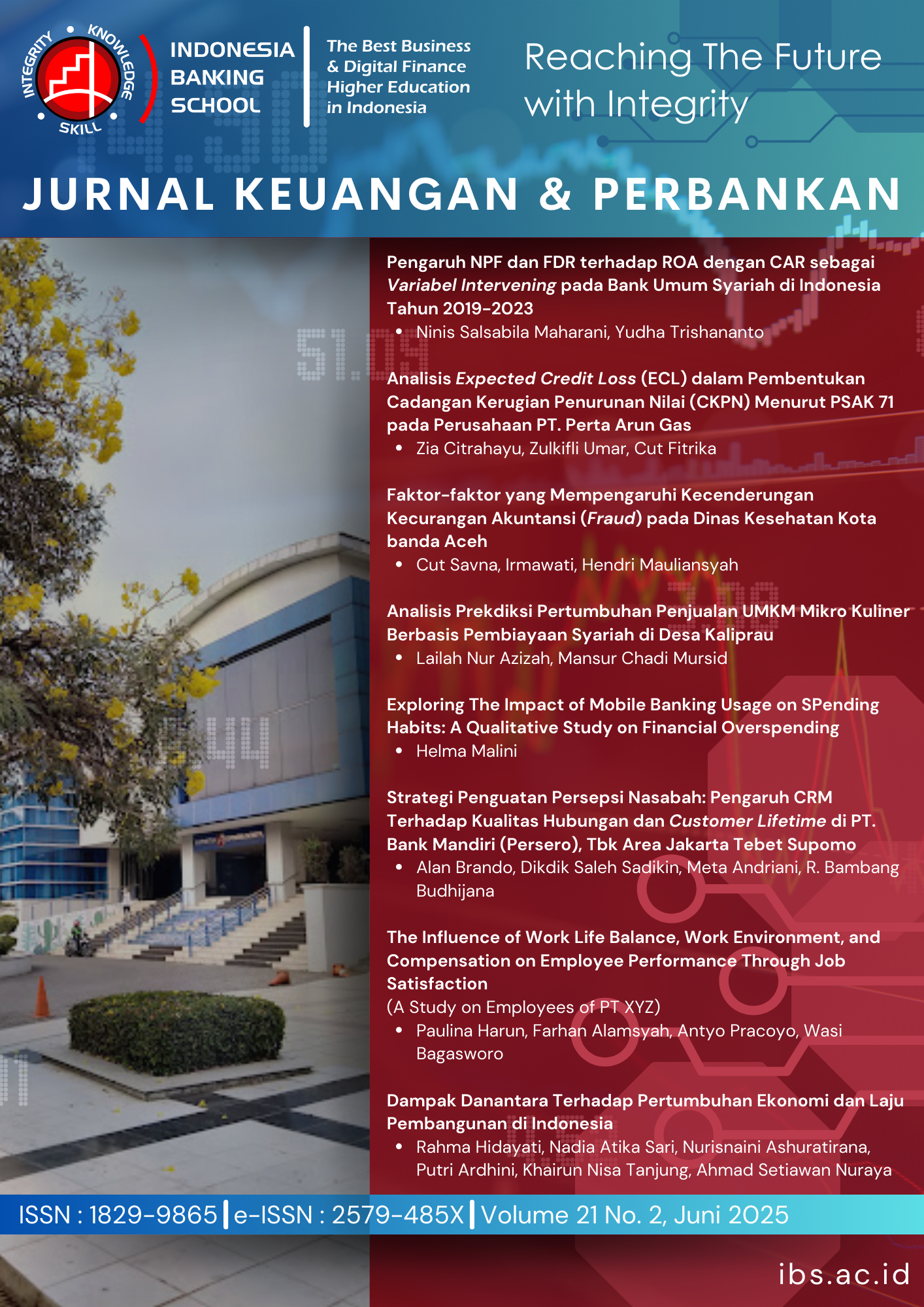
Strategi Penguatan Persepsi Nasabah: Pengaruh CRM Terhadap Kualitas Hubungan dan Customer Lifetime Value di PT. Bank Mandiri (Persero), Tbk Area Jakarta Tebet Supomo
DOI:
https://doi.org/10.35384/jkp.v21i2.652Keywords:
Costomer Relationship Management, Relationship Quality, Costomer Lifetime ValueAbstract
Customer Relationship Management (CRM) is a conceptual paradigm on marketing management perspective that refer to practical series on the implementation of a strategic processes which aimed to improve the relationship quality with customers. Based on bank’s perspective, this paradigm has a significant role to establis long term profitability. The main purpose of this paradigm is to make customer’s loyalty which loyalty is the main problem of bank’s performance growth. The aim of this study is the implementation of CRM at Bank Mandiri in forming customer value which is reflected on historically of Bank Mandiri’s CES, CSAT, NPS, and SES Value. The method used in this study is random sampling method where customers were selected to answer the staements in questionnaire. The analyctical methods that used in this study is Structural Equation Modeling to test the direct effect and indirect effect for each variables. The result of this study show that the Customer Relationship Management has a positive and significant effect on Relationship Quality and Customer Lifetime Value, direct or indirect effect. The result of this study have implication for management, practitioners and academics that bank’s has to improve the capabilities of ther implementation of CRM to increase the relationship quality with customer to improve the customer lifetime value.
Keywords: Customer Relationship Management, Relationship Quality, Customer Lifetime Value
References
Al-hawari, Mohammad A., (2015), “How the Personality of Retail Bank Customers Interferes With the Relationship Between Service Quality and Loyalty”, International Journal of Bank Marketing, Vol. 33, Iss. 1.
Asosasi Penyelenggara Jasa Internet Indonesia, (2024), “APJII Jumlah Pengguna Internet Indonesia Tembus 221 Juta Orang”, APJII, https://apjii.or.id/berita/d/apjii-jumlah-pengguna-internet-indonesia-tembus-221-juta-orang, diakses pada tanggal 27 Februari 2024.
Aurier, P., dan N’Goala, G., (2010), “The Differing and Mediating Roles of Trust and Relationship Commitment in Service Relationship Maintenance and Development”, Journal of the Academy of Marketing Science, Vol. 38, No. 3.
Azzam, Zakaria A. M., (2014), “The Impact of Customer Relationship Management on Customer Satisfaction in the Banking Industry-A Case of Jordan”, European Journal of Business and Management, Vol. 6, No. 32.
Bekmezci, Mustafa, (2013), “Taking Competitive Advantage by Business Model Innovation”, Journal of Management & Economics, Vol. 20, No. 1. Petrakis, P.E., & Konstantakopoulou.
Bose, Ranjit, (2002), “Customer Relationship Management: Key Components for IT success”, Industrial Management & Data Systems, Vol. 102, No. 2.
Boulding, W., Staelin, R., Ehret, M., dan Johnston, W. J., (2005), “A Customer Relationship Management Roadmap: What is Known, Potential Pitfalls, and Where to Go”, Journal of Marketing, Vol. 69, No. 4.
Chen, Chien-Lin, (2012), “Conceptualising Customer Relationship Management and Its Impact on Customer Lifetime Value in the Taiwanese Banking Sector”, A Thesis for the Degree of Doctor of Philosophy, Leicester Business School, De Montfort University.
Cvijović, J., Kostić-Stanković, M., dan Reljić, M., (2017), “Customer Relationship Management in Banking Industry: Modern Approach”, Journal of Industrija, Vol. 45, No. 3.
Dachlan, Usman, (2014), Panduan Lengkap Structural Equation Modeling-Tingkat Dasar, Semarang : Lentera Ilmu.
Eggert, Wolfgang Ulaga Andreas, (2006), “Relationship Value and Relationship Quality”, European Journal of Marketing, Vol. 40.
Gebert, Henning. Geib, M. Kolbe, L. and Brenner W., (2003), “Knowledge-Enabled Customer Relationship Management: Integrating Customer Relationship Management and Knowledge Management Concepts (1)”, Journal of Knowledge Management, Vol 7 No. 5, MCB UP Limited.
Goodman, J., O’Brien, P., dan Segal, E., (2000), Selling Quality to the CFO, Arilington: Quality Progress.
Gupta, Sunil, and Zeithaml, Valerie, (2006), “Customer Metrics and Their Impact on Financial Performance”, Marketing Science, Vol. 25 No. 6, pp. 718-739.
Hair, J.F., Black, W.C., Babin, B.J. and Anderson, R.E. 2010, Multivariate Data Analysis: A Global Perspective, 7th ed., Pearson Prentice Hall, NJ.
Helgesen, Oyvind, (2006), “Are Loyal Customers Profitable? Customer Satisfaction, Customer (Action) Loyalty and Customer Profitability at the Individual Level’, Journal of Marketing Management, Vol. 22.
Hennig-Thurau, T., dan Klee, A., (1997), “The Shadow of the Future: Effects of Anticipated Interaction and Frequency of Contact on Buyer-Seller Cooperation”, Academy of Management Journal, Vol. 35.
Izogo, Ernest Emeka, (2016), “Should Relationship Quality be Measured as a Disaggregated of a Composite Construct?”, Management Research Review, Vol. 39, Emerald Group Publishing Limited.
Kim, Woo Gon and Cha, Youngmi, (2002), “Antecedents and Consequences of Relationship Quality in Hotel Industry”, International Journal of Hospitality Management, Vol. 21.
Kotler, P., Armstrong, G., Wong, V., dan Saunders, J. A., (2008), Principles of Marketing, 4th Ed, Upper Saddle River, NJ: Pearson Education.
Kurniati, R. R., Suharyono, D. Hamid, dan Arifin, Z., (2015), “The Effect of Customer Relationship Management (CRM) and Service Quality to Corporate Image, Value, Customer Satisfaction, and Customer Loyalty”, European Journal of Business and Management, Vol. 7, No. 11.
Leu, H. D., dan Hsieh, I. W., (2000), “Relationships Among Customer Satisfaction, Brand Equity, and Customer Lifetime Value” Chung Yuan Journal, Vol. 28, No. 2.
Markides, Constantinos, (2006), “Disruptive Innovation: In Need of Better Theory”, Journal of Product Innovation Management, Vol. 23, No. 1, pp. 19- 25.
Muhamad, (2008), Metodologi Penelitian Ekonomi Islam, Jakarta: Rajawali Pers.
Nyman, H., (2014), “The Added Value of Service Provision”, International Journal of Bank Marketing, Vol. 32.
Otoritas Jasa Keuangan, (2023), “Edukasi Konsumen: Keuangan Digital, Kunci Perekonomian Indonesia 2045”, Jakarta: Otoritas Jasa Keuangan.
Padmavathy, C., Balaji, M.S. and Sivakumar, V.J., (2012), “Measuring Effectiveness of Customer Relationship Management in Indian Retail Banks”, International Journal of Bank Marketing, Vol. 30 No. 4.
Parvatiyar, A. & Sheth, T.N., (2002), "Customer Relationship Management: Emerging Practice, Process, and Discipline", Journal of Economic and Social Research, Vol. 3, No. 2.
Peppers, D., dan Rogers, M., (1993), The One to One Future: Building Relationships One Customer at a Time, New York: Doubleday.
Rai, Alok Kumar dan Srivasta, Medha, (Oktober-November, 2012), “Customer Loyalty Atributes: A Perspective”, NMIMS Management Review, Volume XXII.
Reichheld, F. F., dan Sasser, W. E., (1990), “Zero Defections: Quality Comes to Service”, Harvard Business Review, Vol. 68.
Riadi, Edi, (2018), Statistik SEM (Structural Equation Modeling) dengan LISREL, Jakarta: Andi Publisher.
Schmid, R.E., (2001), “An Architecture of Customer Relationship Management and Process Portals for Banks”, Thesis University of St Gallen, St Gallen.
Seyyednejad, Seyyedah M., Alipur, Hossein, and Feizi, Mohammad, (2013), “Surveying the Relationship Between Relationship Marketing and Customer Loyalty, Case Study: Pasargad Bank in Mazandaran Province”, International Journal of Management and Social Sciences Research, Vol. 2, No. 3.
Sustainability Report PT. Bank Mandiri (Persero), Tbk., Tahun 2021.
Sustainability Report PT. Bank Mandiri (Persero), Tbk., Tahun 2022.
Sustainability Report PT. Bank Mandiri (Persero), Tbk., Tahun 2023.
Swift, R. S., (2000), Accelerating Customer Relationships Using CRM and Relationship Technologies, Prentice Hall.
Downloads
Published
How to Cite
Issue
Section
License
Copyright (c) 2025 Jurnal Keuangan dan Perbankan

This work is licensed under a Creative Commons Attribution-NonCommercial 4.0 International License.
 Abstract Views: 433
|
Abstract Views: 433
|  File Downloads: 419